Steven Spielberg is rightly regarded as a cinematic genius, and more than that, he’s a director known for always taking his audience on an unforgettable journey, in the way that only movies can. Spielberg’s talent as a filmmaker is so masterful that he elevates the work of others whenever he adapts a book or remakes a classic film. That’s never been truer than with Spielberg’s most famous and enduring film, which completely transformed the best work of one of the most acclaimed and bestselling authors of the time.
When Michael Crichton published Jurassic Park in 1990, he was on an unprecedented hot streak. After writing The Andromeda Strain in 1969 and building his career with modest hits, Crichton crushed the 1980s by publishing three hit sci-fi/horror novels, Congo (1980), Sphere (1987), and Jurassic Park (1990), all of which were adapted into financially and/or critically successful films in the 1990s.
Sci-fi/horror may have been the sub-genre that Michael Crichton was playing in, but Hollywood wasn’t willing to get so dark with the film adaptations. Jurassic Park got the biggest stylistic makeover, including a new ending that completely misses the point of the book.
As stated, Michael Crichton’s Jurassic Park is an entirely different experience from Spielberg’s film. Crichton’s novel is about the intersection of science, business, and entertainment, and the hubris of one man (John Hammond) who thinks he can play God and reverse the course of evolution. The book has much more of a horror-thriller tone, with more deaths than we saw in Spielberg’s film, and more brutal descriptions of how those deaths occur.
The ending of the novel is the biggest change that was made for the film. We all know Steven Spielberg’s penchant for telling cinematic stories about broken families (or found families) that are brought together through extreme circumstances; in that sense, it makes sense that his version of Jurassic Park climaxes with Dr. Alan Grant’s (Sam Neill) rise to surrogate fatherhood, and ends with Grant and Dr. Ellie Sattler (Laura Dern) as parental figures to Lex (Ariana Richards) and Tim (Joseph Mazzello).
Crichton’s novel goes an alternate route: Tim and Lex survive a raptor attack in Jurassic Park’s kitchen and visitor center (using a baby raptor as bait) and meet up with Dr. Grant. However, the book once again takes a darker sci-fi turn as Grant and Co. go into the raptor hatchery and have to kill off the surviving animals, as well as tracking and killing the ones trying to infiltrate the mainland. The surviving group is evacuated, and the island is “quarantined” by being bombarded with napalm to kill off the remaining dinosaurs (and evidence). No one who makes it out of Jurassic Park is treated like a hero: they are all detained in a Costa Rican hotel for weeks while an investigation is done. As a final grim cliffhanger, Grant is visited by a scientist who reports sightings that suggest some of the raptors made it off Isla Nublar, teasing that dinosaurs were on an inevitable course to reclaim their place at the top of Earth’s food chain, thanks to Hammond.
The first thing that lets you know Steven Spielberg’s Jurassic Park had very different thematic goals than Crichton’s novel is the arc of John Hammond. In the movie, Hammon makes it off Isla Nublar, but is “humbled” by the failure of Jurassic Park, and his own hubris: But never do we see Hammond actually punished for what he did, and all the deaths he’s responsible for.
Crichton’s novel makes sure that Hammond gets his just due by the end: InGen’s CEO is left shell-shocked from the death and carnage that occcurs in Jurassic Park; as the dinos are being neutralized, and the island reclaimed, Hammond wanders the grounds, contemplating what InGen will do next, only to stumble and fall down a hillside, where he is ambushed by a pack of small dinos, Procompsognathus, and torn to pieces. Crichton clearly intended a harsh karmic message about corporate greed and billionaires playing god with nature – a message which Spielberg’s film misses entirely.
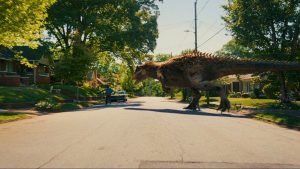
On the opposite end of that spectrum, Crichton delivered the harsh blow of seemingly killing off mathematician and chaos theorist Ian Malcolm, who dies from the injuries he suffers during the Tyrannosaurus rex chase. That obviously wouldn’t have been as effective in the movie, sicne Jeff Goldblum was such a fan-favorite breakout in the role. Finally, if you can’t tel the entirely different planes Crichton and Speilberg are operating on: lawyer Donald Gennaro is a heroic figure who survives the novel; the movie pastes Gennaro’s name and job over a different book character’s arc: InGen PR head Ed Regis. Hollywood not wanting to mock a PR representative or their profession is the epitome of taking “creative liberty” with a book adaptation.
At the end of the day, Speilberg’s film about found family and satirizing entertainment/theme park industry giants like Disney, resulted in much wider box office success and generational legacy. As we’ve seen from many films that came after (including some Jurassic Park/World sequels), the darker, sci-fi-horror approach doesn’t get nearly as much love. But let’s not forget what Jurassic Park originally was, before Hollywood got ahold of it.
You can stream Jurassic Park movies on Peacock. Discuss rebooting classic sci-fi films with us on the ComicBook Forum!